

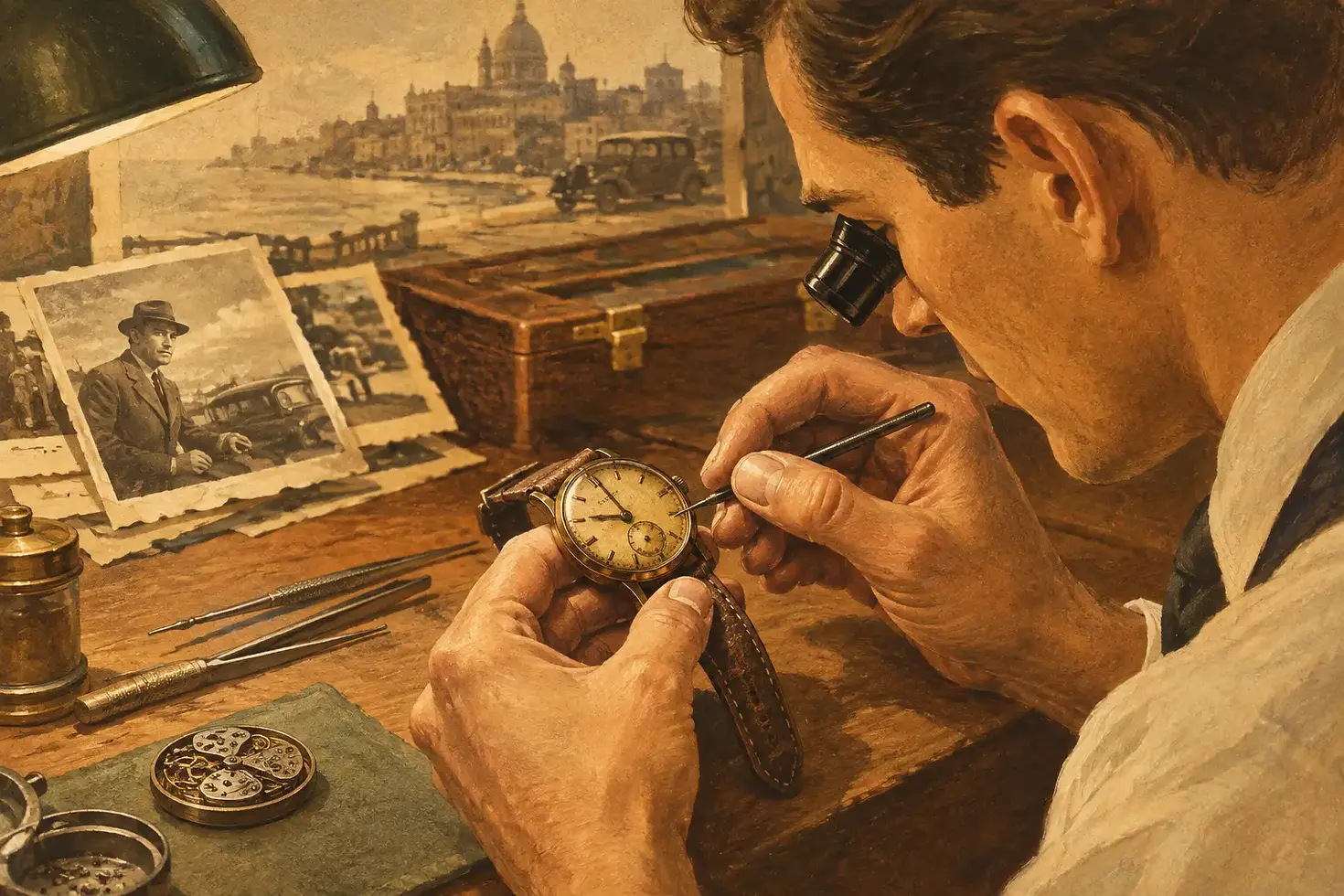
Watch Restoration Without Erasing Its History

A hairline mark on an 18-karat gold case, a softly aged dial, the faint warmth of old lacquer beneath the crystal: these are not necessarily flaws to be removed. In serious watch restoration, they are often the visible record of a life well lived. The task is not to make a vintage watch look newly manufactured. It is to return its function, stability, and dignity while protecting the character that time has written into it.
For collectors, this distinction is decisive. A watch may be restored beautifully and still lose the very details that made it desirable. Conversely, a piece left untouched in the name of originality may carry unseen mechanical wear that places its future at risk. The finest work lives in the measured space between intervention and restraint.
Watch Restoration Is an Act of Conservation
A vintage timepiece is a compact work of engineering, but it is also an artifact of design, material culture, and personal memory. Its dial reflects the visual language of an era. Its movement reveals the technical standards of the manufacture that created it. Its case, whether shaped in restrained steel or luminous gold, carries evidence of decades spent on a wrist.
This is why restoration should begin with understanding rather than polishing. Before a watchmaker touches a screw or opens a case back, the piece must be examined as a whole: its reference, serial number, movement caliber, dial configuration, hands, crown, crystal, bracelet or strap, and signs of prior work. Each element can affect both authenticity and value.
A Cartier dress watch with an original dial showing gentle, even aging may be more compelling than the same reference with a fresh but incorrect replacement dial. A Titus Genève with its original signed crown and period-correct hands holds a clearer connection to its history. In such cases, perfection is not the objective. Integrity is.
The Movement Deserves Immediate Attention
Mechanical deterioration is rarely dramatic at first. Lubricants dry, thicken, or migrate. Tiny particles from worn components circulate through the movement. A mainspring loses its consistency. Moisture can leave oxidation beneath the dial long before it becomes visible from the front.
A rigorous service begins with careful disassembly of the movement. Every component is inspected, cleaned, and evaluated under magnification. Worn parts should be replaced only when necessary, ideally with correct period components or expertly made equivalents where originals can no longer be sourced. The movement is then reassembled, lubricated according to its caliber's requirements, adjusted, and tested for rate, amplitude, and power reserve.
This work has little to do with cosmetic transformation. It is the quiet discipline that allows a watch to resume its purpose: marking time faithfully. A vintage watch does not need to be made young again. It needs to be made safe to wear and capable of continuing its story.
A service is not always a full restoration
The terms are often used interchangeably, though they describe different levels of intervention. A movement service addresses the health and performance of the mechanism. Restoration may also involve work on the case, dial, hands, crystal, crown, and other visible elements.
The right choice depends on condition and rarity. A watch that runs poorly but retains an exceptional original dial may need a complete mechanical service and almost no cosmetic work. Another may have a damaged crystal, compromised crown, and neglected case that require sympathetic attention before it can be worn with confidence. The watch itself should determine the treatment.
The Dial Is Where Restraint Matters Most
Collectors often speak of a dial as a watch's face, but the comparison understates its significance. The dial is where design, age, and identity meet. Its typography, minute track, applied numerals, luminous material, and surface texture can distinguish an ordinary example from an exceptional one.
Refinishing a dial is therefore among the most consequential decisions in watch restoration. It can be justified when water damage, corrosion, or severe deterioration has erased the dial's legibility and coherence. Yet an indiscriminate refinish can flatten detail, alter printing, change the original tone, or replace an irreplaceable patina with a sterile surface.
A lightly spotted silver dial, a warm ivory shift, or a matching patina on luminous hands and markers may be precisely what gives a vintage watch its presence. These features should not be confused with neglect. They are often the marks that confirm a watch has remained close to its original state.
The same principle applies to hands. Replacing them may improve brightness, but it can also disrupt the visual harmony of an aged dial. When preservation is possible, stabilization and gentle cleaning are generally more faithful than replacement. When replacement is unavoidable, correct proportions, period style, and finish are essential.
Cases, Crystals, and the Danger of Over-Polishing
A gold case invites polish because it responds so beautifully to light. Yet gold is soft, and each aggressive polishing session removes material. Over time, sharp lugs become rounded, hallmarks soften, case edges lose definition, and the watch's original proportions drift away.
A careful case restoration does not mean eliminating every sign of wear. It may involve removing surface grime, treating oxidation, restoring a crystal's clarity, and applying only the most controlled refinishing when appropriate. The goal is to preserve the architecture of the case: its bevels, edges, brushed surfaces, polished planes, and stamped marks.
This matters especially for historically important pieces. The crisp geometry of a mid-century case or the sculptural curve of a classic dress watch is part of its design authorship. A case that has become too smooth can look attractive at a glance while having lost much of its collector meaning.
A replacement crystal is often a sensible and protective intervention when the original is cracked, heavily scratched, or no longer seals adequately. Crowns require a similarly careful judgment. A non-original crown may reduce a watch's appeal, but a failing crown can expose the movement to moisture. Whenever an original component can be retained and made dependable, that is usually the preferred path.
Provenance Is Part of the Restoration
A watch does not become more authentic merely because it has been serviced. Authenticity rests on the coherence of the entire object. Are the movement and case correct to one another? Does the dial correspond to the reference? Are the signature, serial numbers, and hallmarks consistent? Have later alterations been identified honestly?
Documentation should follow the work. A discerning owner deserves to know what was cleaned, repaired, replaced, or deliberately left untouched. This record creates confidence for the current wearer and for the next custodian. It also distinguishes thoughtful restoration from cosmetic concealment.
At Cortina Classics, this philosophy treats each selected watch as more than a luxury possession. It is an object of portable art, entrusted with a mechanical and cultural inheritance. The standard is not simply that a piece should look desirable in a presentation case. It should remain truthful when examined closely by a collector's eye.
Choosing the Right Level of Intervention
There is no universal formula. The correct restoration for a rare, original watch may be radically different from the work appropriate for a frequently worn vintage piece. A collector preserving a historically significant reference may accept signs of age that another owner would find distracting. Someone purchasing a gold dress watch to wear at formal occasions may reasonably prioritize reliability, a clean crystal, and a secure crown.
The essential question is not, “Can this be made to look new?” It is, “What must be done for this watch to live well from here?” That question honors both the object and the person who will wear it.
Before approving any work, ask for a clear condition assessment, an explanation of proposed interventions, and an account of which original components will remain. A restoration worthy of a fine watch should make its future more secure without making its past disappear.
The most satisfying vintage watches still show that they have traveled through time. When their mechanisms are cared for and their surfaces treated with judgment, they offer something a new object cannot imitate: the quiet assurance of history, still keeping time.

Commentaires